
The Permacrisis
I did this piece on 30 November 2022 when this latest crisis was first kicking off and it seemed the situation could go either way.

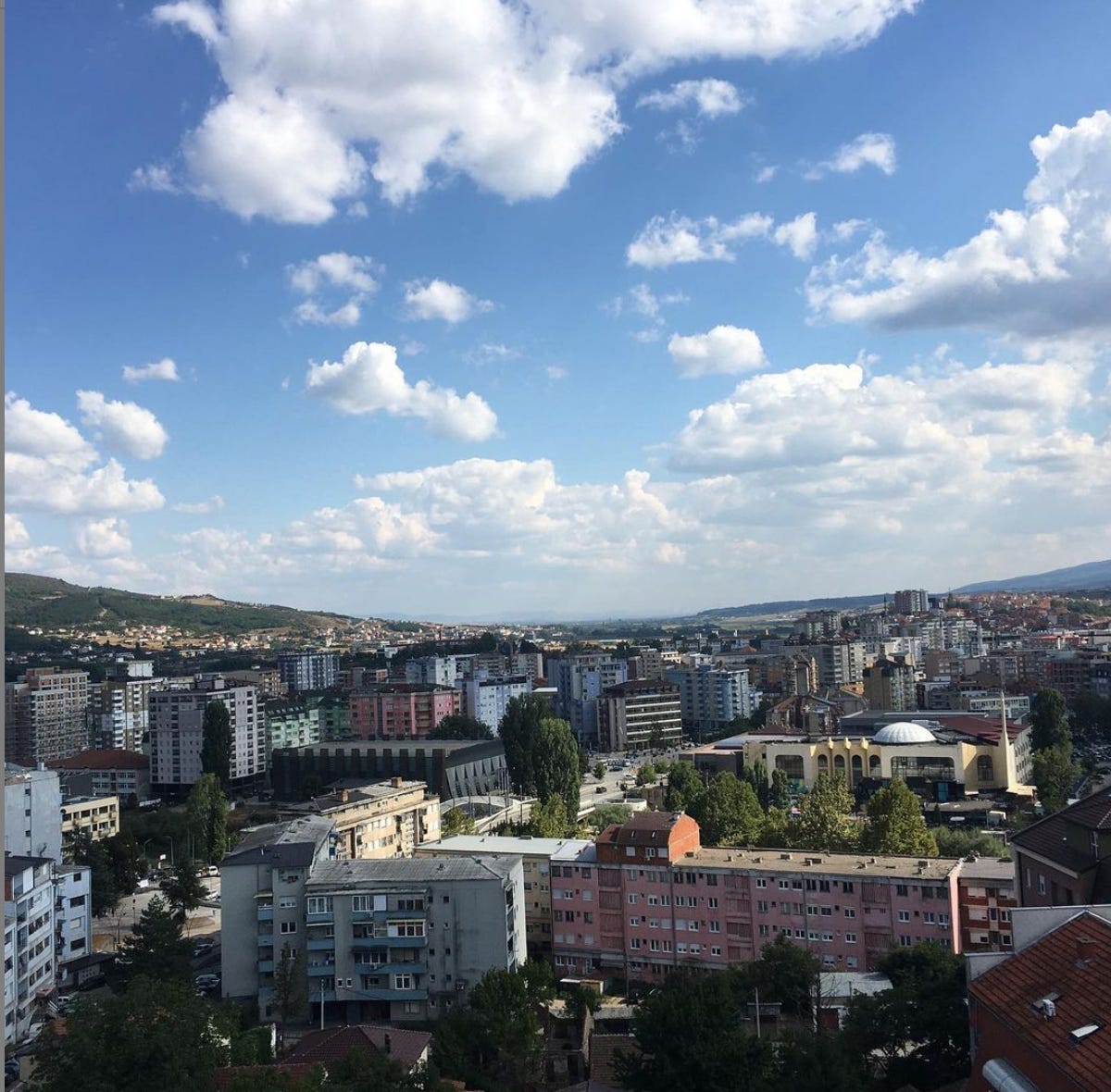
Other than the new Serbian flags donning the main square the normal fall quiet was only broken by kids playing football after school. Now that the cafes had mostly retreated indoors as the chill started to settle in the air, there wasn’t much going on aside from the late afternoon shoppers bustling for the last of the sausages, gossiping with shopkeepers or settling in for lunch, coffee or beers in the pubs, cafes and restaurants.
People - both Albanians and Serbs - were crossing the bridge and there were a few more KFOR and Italian Carabinieri vehicles and Kosovo police cars parked on it. Two or three journalists walked around the circle with the Prince Lazar statue looking for “tensions”, meanwhile people ignored them and went along with their business.
But on the 5th November, over 500 police, judges, prosecutors and several hundred Serbian government workers resigned from state institutions because of the enforcement of RKS licence plates in north Kosovo by the Kosovo government.
About 6-7, 000 cars by some estimates (the Kosovo government estimates around 10,000) have the old prewar plates. There have been reports of cars being torched if their owners re-registered them.
The crisis means that Kosovo’s judicial and policing system has broken down in the north and a full constitutional crisis looms. Prime minister Kurti claimed that Kosovo Serbs left the Kosovo government institutions because the Serbian government - in cahoots with the Russians - forced them to do so.
However, many Kosovo Serbs cite a list of grievances against the Kurti government that they say led to this crisis, including the lack of initiatives to try and begin reconciliation; the hardline approach to every problem and the lack of dialogue between the Kosovo government and the Kosovo Serb community. The executive director of NGO Aktiv, Miodrag Milicevic, said he was physically and verbally abused by Kosovo Special Police nearthe Jarinje border crossing.
On Thursday, 16 November, a Kosovar Albanian cameraman for Insajderi and a 15 year old Kosovar Albanian boy were allegedly assaulted in Mitrovica North by a Serbian gang.
As a result they claim that relations and the dialogue itself has taken a step back. One Kosovo Serbian administrative worker from the Basic Court said that the judicial and rule of law integration was the most successful thing to come out of the dialogue and “This is his greatest success. He (Kurti) managed to completely destroy the only successful multi-ethnic and Brussels story with his stupid actions regarding harmless things... He will destroy much more, but that's someone else's problem”
Both the European Union and the United States have asked that the Kosovo Serbs return to the institutions, “We call on Serbia and Kosovo Serb representatives to respect their Dialogue obligations and return to the Kosovo institutions to fulfill their duties, including in the Police, Judiciary and local administrations, '' the EU says.
They also ask that the Kosovo government delay the licence plate enforcement, and implement the Association of Serbian Communities immediately. The Kosovo government agreed to this in 2013 but has so far not made it happen.
The Kurti government stands firmly against the Association, with President Vjosa Osmani saying that the Constitutional Court rejected the Association as unconstitutional. However, what the Court actually said was that it was Constitutional but with a few changes to have it completely aligned, the EU and the US are insistent, with the EU noting,
“The EU also calls on Kosovo to immediately start steps to establish the Association/Community of Serb Majority Municipalities. The Kosovo Assembly has ratified the Brussels Agreement and Kosovo’s Constitutional Court ruled that the Association/Community needs to be established. Therefore, its establishment is a binding legal obligation for Kosovo. Continued failure to implement this obligation undermines the principle of Rule of Law and damages Kosovo’s reputation and credibility.”
Kurti also said in a press conference that this is happening because Serbia does not want to accept the French-German proposal for the Dialogue. Peter Stano, the foreign policy spokesperson for the European Union, told New Perspektiva:
“The EU, supported by France and Germany, has presented a proposal to the Parties to make concrete and irreversible progress on the road to comprehensive normalisation of their relations…. We now have received the answers from both parties and we are studying them.”
At this point both communities are severely divided with Kosovo Albanians insistent that Serbs were told to leave by their government, “and they will get a stipend from the Serbian government. But they don’t want to leave their jobs,” one Kosovo Albanian businesswoman and NGO leader in Mitrovica who works with and has friendships with many Kosovo Serbs, said. “My friends are still coming for coffee.”
Meanwhile, many Kosovo Serbs are just as insistent that they themselves chose to leave and that the Kurti government has been failing them for some time, this is about a lot more than licence plates. Kosovo Serb civil society activist, Milica Andrić Rakić wrote in a widely read opinion piece for Balkan Insight that, "Kosovo Serbs exiting and dismantling Kosovo institutions is not about Russian influence, it is Kurti’s influence.”
On 21 November, after what Kurti described to RTK as, “a total of 6 meetings, lasting 8 hours," an agreement could not be found and the EU admitted it had reached a stalemate blaming both sides, “I will inform [the EU] Member States, Foreign Ministers and our partners about the unconstructive behaviour of Parties and complete lack of respect for their [international] legal obligations, and this goes in particular for Kosovo. This sends a very negative political signal." Josep Borrell, High Representative of the EU for Foreign Affairs and Security Policy said in a statement.